

Loading
Phone +44 116 243 6250 Email enquiries@guidanceautomation.com
Guidance Automation
  • How Does It Work?
  • Solutions
    • Autonomous Vehicles
    • Autonomous Vehicle Tops & Modules
    • Light-Directed Material Handling
      • Pick to Light Systems
      • Put to Light System
    • Beacon Navigator
  • Industries
    • Manufacturing
    • Warehousing
    • Agri-Tech
    • Hospitals
  • Resources
    • FAQ
    • Download Our Autonomous GO Brochure
    • Videos
    • Case Studies
    • Datasheets
    • News & Blog
  • Contact Us
    • Events
  • About Us
  • Menu Menu

Material Movement Automation: The Missing Layer in Smart Manufacturing
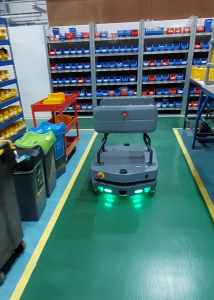
Guidance Automation autonomous vehicle transporting materials through a manufacturing facility

Most manufacturers have invested in automating their processes. Yet the movement of materials between those processes often remains manual.

Across many production environments, a significant proportion of time is still spent walking, waiting, and transporting materials from one location to another. Studies suggest this can account for 30 to 50% of a production worker’s time. It is a substantial and often overlooked drain on productivity that rarely appears on performance dashboards.

As manufacturers continue to embrace factory automation, robotics and smart manufacturing technologies, improving what happens between production processes is becoming just as important as optimising the processes themselves.

The Hidden Cost of Material Movement

While robotics and automation have transformed many individual manufacturing processes, the flow of materials between those processes is frequently still manual.

This creates friction in otherwise efficient operations. Machines may run at optimum speed, but production can still be constrained by delays in getting materials to the right place at the right time. Operators spend valuable time collecting components, moving work-in-progress, replenishing production lines, or transporting finished goods rather than focusing on value-adding activities.

These tasks are necessary, but they do not require skilled labour. Yet they consume a significant amount of it.

Why Automation Often Stops at the Process

Historically, automation projects have focused on production equipment itself. Manufacturers have invested in faster machines, improved tooling, machine vision systems and automated production cells to increase output and improve quality.

However, the movement of materials between those automated processes has often been left unchanged.

As labour availability continues to challenge manufacturers and pressure grows to improve productivity, this gap is becoming increasingly difficult to ignore. Many businesses are now looking beyond individual processes and considering how internal logistics and material handling automation can improve overall factory performance.

The Rise of Autonomous Material Transport

This is where autonomous mobile systems are gaining traction.

Autonomous mobile robots (AMRs) and autonomous vehicles can take on repetitive transport tasks such as moving materials between workstations, delivering components line-side, transferring work-in-progress, or transporting finished goods to the next stage of production.

The impact can be immediate. Skilled employees are freed from low-value transport activities and can focus on tasks that directly support output, quality and continuous improvement. At the same time, material flow becomes more consistent, helping to reduce delays and support smoother operations.

Importantly, modern autonomous systems can often be introduced into existing manufacturing environments with minimal disruption. Rather than requiring wholesale change, manufacturers can target specific pain points and expand automation as requirements evolve.

A Lower-Risk Route to Automation

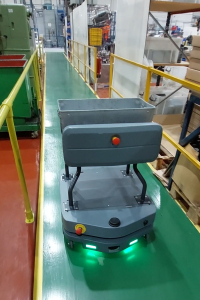
Commercial models are also evolving.Autonomous mobile vehicle carrying a materials tote through a manufacturing production area
Traditionally, automation has been associated with significant capital expenditure and lengthy approval processes. Today, more flexible approaches are helping manufacturers introduce automation without the upfront investment typically associated with large-scale projects.

Usage-based models allow businesses to trial and scale automation in line with operational requirements, making it easier to demonstrate value before expanding deployment.

This lowers the barrier to entry and enables manufacturers to focus on operational outcomes rather than infrastructure investment.

Looking Beyond the Production Process

As manufacturers look to increase output, improve efficiency and make better use of their workforce, the opportunity is not only within processes, but between them.

Addressing internal material movement may not be the most visible form of automation, but it is often one of the most impactful.

The next gains in manufacturing productivity won’t come from faster processes, but from fixing what happens between them.

At Guidance Automation, we help manufacturers automate internal material transport using autonomous vehicles that integrate into existing production environments. Through our Automation by the Hour model, Autonomous GO, manufacturers can introduce automation without capital investment and pay only for the hours worked.

If reducing wasted time across your facility is a priority, get in touch to discuss how autonomous material transport could support your operation.

Latest News

  • Autonomous Palletising by the HourMay 21, 2026
  • Autonomous Mobile Picking Vehicle TrialFebruary 11, 2026
  • Guidance Automation Trials Hydrogen Fuel Cell-Powered Autonomous Vehicle with Intelligent EnergyDecember 1, 2025
  • Autonomous GO Launch: Pay-by-the-Hour Robot WorkersJuly 9, 2025
  • Otto Motorr Autonomous mobile Robots or AMRs as they are also know.
    Visit Guidance Automation at Tomorrow’s Warehouse 2023May 19, 2023

Latest Blog

  • Guidance Automation autonomous vehicle transporting materials through a manufacturing facility
    Material Movement Automation: The Missing Layer in Smart ManufacturingJune 30, 2026
  • How Do Leading Manufacturers Deploy Robotics While Maintaining Full Production Capacity?May 19, 2026
  • Automation Should Not Require Reinventing Your FactoryMarch 2, 2026
  • Pick-to-Light Explained: Using Light for DirectionSeptember 8, 2023
  • Industry 4.0 and The Internet of Things
    Industry 4.0: What Manufacturers Need to KnowAugust 30, 2023

Contact Us

+44 116 243 6250
enquiries@guidanceautomation.com

Social Media

Linkedin Twitter YouTube

Visit Us

Guidance Automation Ltd
Unit 2 Meridian South
Meridian Business Park
Leicester
LE19 1WY
United Kingdom

View Map

Additional Links

Site Map
Privacy & Cookie Policy

©2026 Guidance Automation Ltd | Company Registered in England No. 9200454

Quick Enquiry

Please fill in the form below and a member of our team will be in touch shortly to assist.


    Yes, I want to receive Guidance Automation's e-Newsletters

    Quick Enquiry

    Link to: Autonomous Palletising by the Hour Link to: Autonomous Palletising by the Hour Autonomous Palletising by the Hour

    This site uses cookies. By continuing to browse the site, you are agreeing to our use of cookies.

    Accept Reject


    How we use cookies

    We may request cookies to be set on your device. We use cookies to let us know when you visit our websites, how you interact with us, to enrich your user experience, and to customize your relationship with our website.

    Click on the different category headings to find out more. You can also change some of your preferences. Note that blocking some types of cookies may impact your experience on our websites and the services we are able to offer.

    Essential Website Cookies

    These cookies are strictly necessary to provide you with services available through our website and to use some of its features.

    Because these cookies are strictly necessary to deliver the website, refusing them will have impact how our site functions. You always can block or delete cookies by changing your browser settings and force blocking all cookies on this website. But this will always prompt you to accept/refuse cookies when revisiting our site.

    We fully respect if you want to refuse cookies but to avoid asking you again and again kindly allow us to store a cookie for that. You are free to opt out any time or opt in for other cookies to get a better experience. If you refuse cookies we will remove all set cookies in our domain.

    We provide you with a list of stored cookies on your computer in our domain so you can check what we stored. Due to security reasons we are not able to show or modify cookies from other domains. You can check these in your browser security settings.

    Other external services

    We also use different external services like Google Webfonts, Google Maps, and external Video providers. Since these providers may collect personal data like your IP address we allow you to block them here. Please be aware that this might heavily reduce the functionality and appearance of our site. Changes will take effect once you reload the page.

    Google Webfont Settings:

    Google Map Settings:

    Google reCaptcha Settings:

    Vimeo and Youtube video embeds:

    Privacy Policy

    You can read about our cookies and privacy settings in detail on our Privacy Policy Page.

    Guidance Automation Privacy and Cookie Policy
    Accept settingsHide notification only