

From Manual Material Movement to Scalable Automation: A 5-Stage Roadmap
Automation doesn’t have to begin with a complete transformation of your factory.
For many manufacturers, a better starting point is much simpler: where are skilled people spending time on repetitive tasks that don’t require their skills?
Moving materials between processes, fetching components, replenishing lines and transferring finished goods all need to happen. But when these tasks repeatedly take people away from skilled, productive work, they can create an opportunity for automation.
The challenge is knowing where to begin, and what should happen once that first opportunity has been identified.
Here’s a five-stage roadmap for moving from manual material movement to automation that can develop alongside your operation.
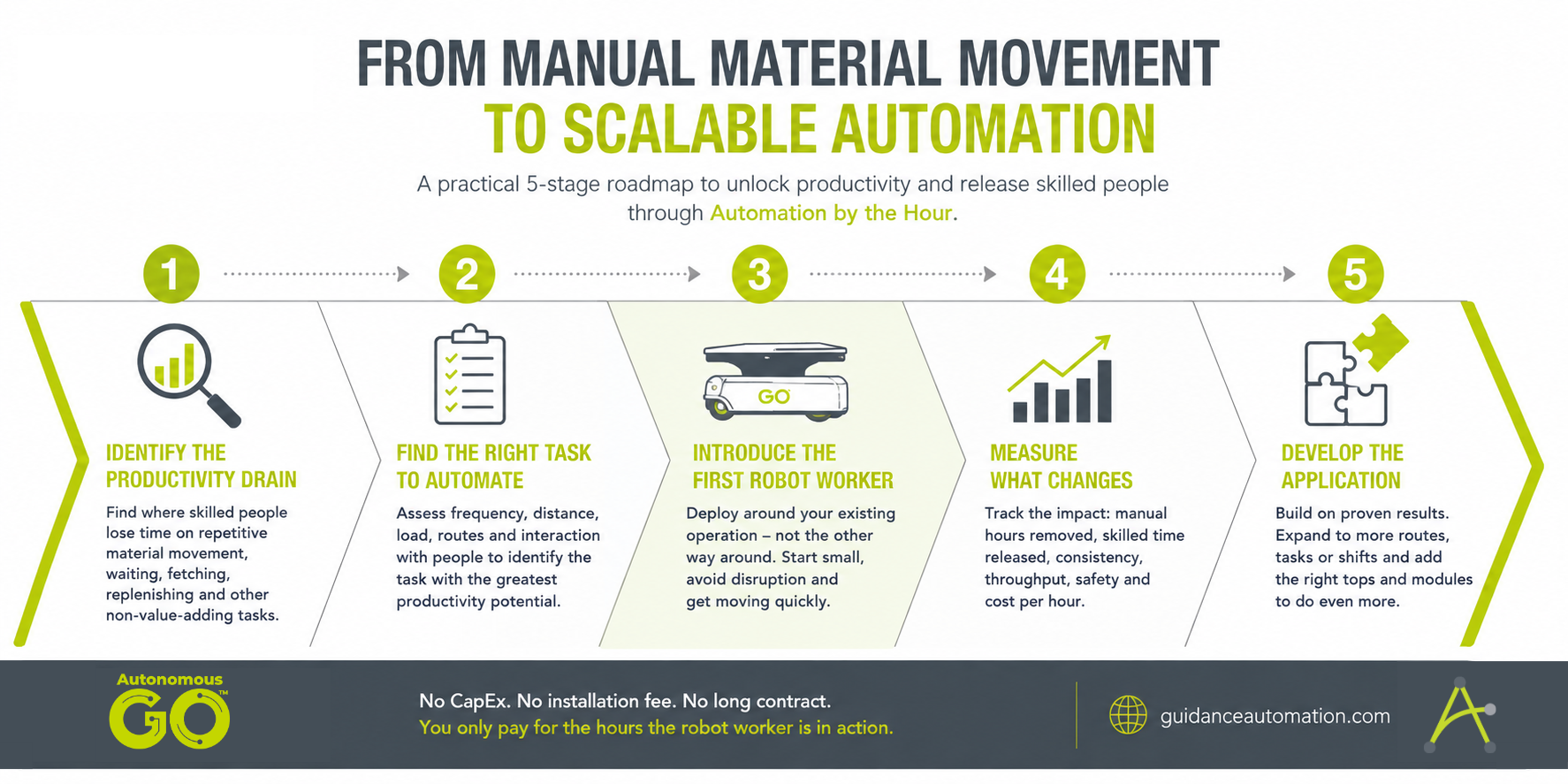
1. Identify the productivity drain
Before thinking about vehicles or technology, look at what is happening on the factory floor.
Where are people regularly walking or driving between processes? Where are operators waiting for materials? Which repetitive movements are taking skilled employees away from the work you actually need them to do?
These individual journeys can appear insignificant. Repeated throughout a shift, across several employees and over an entire year, the lost productive time can quickly add up.
The starting point for automation should therefore be the business problem, not the technology.
2. Find the right task to automate
Not every manual movement needs to be automated, and identifying the right application is an important part of getting useful results.
Consider factors such as the frequency of the task, distance travelled, load being transported, collection and delivery points, interaction with people and how predictable the movement is.
Most importantly, look at what changes if that task is removed from an employee’s workload.
If automating a repetitive transport task means a welder can spend more time welding, an operator can remain at a machine or a production team no longer needs to interrupt its work to fetch materials, there is a clear productivity opportunity.
That was the case for one medical device manufacturer working with Guidance Automation, where repetitive transport was taking skilled welders away from production. Automating those movements allowed the welders to remain focused on skilled production work.
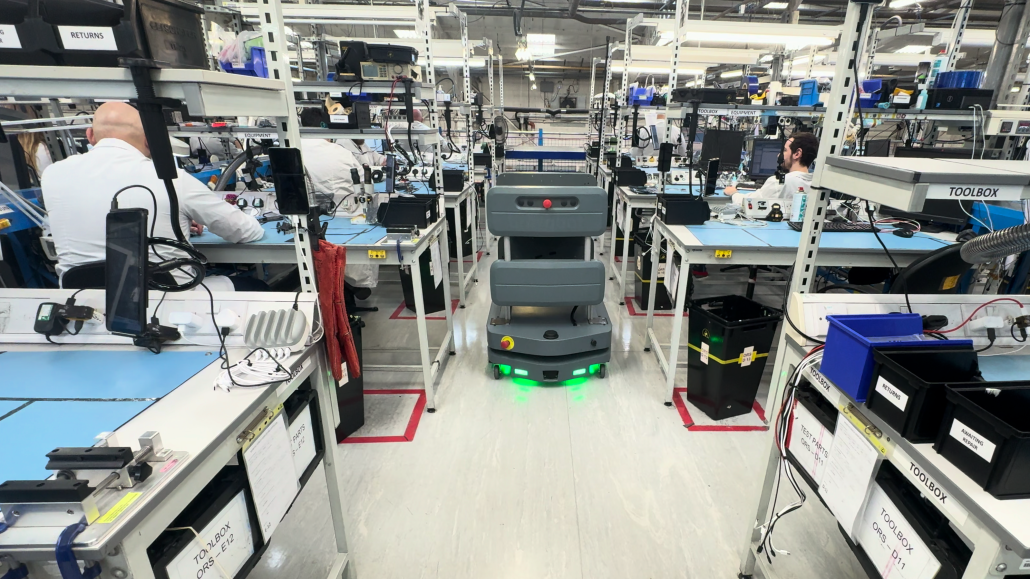
3. Introduce your first robot worker
Once the right application has been identified, automation should work around the operation rather than forcing the operation to work around the automation.
Autonomous vehicles can take on repetitive material movements while operating alongside existing processes and people. The appropriate vehicle and application-specific top can then be selected according to what actually needs to be moved and how it needs to interact with the surrounding process.
This could be as straightforward as carrying totes or components between two locations, or involve conveyor transfer, lifting, shelving or light-directed picking.
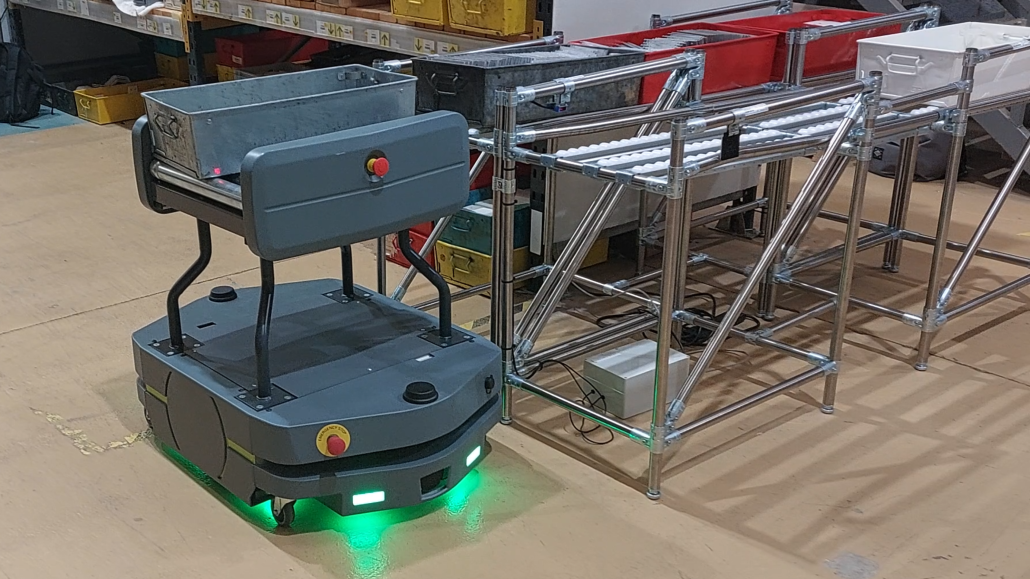
The objective at this stage isn’t to automate everything. It’s to put automation to work where it can deliver a worthwhile result.
4. Measure what changes
Once the robot worker is operating, the focus shifts from what the technology can do to what it is actually achieving.
How many hours of manual movement have been removed? How much skilled time has been released? Has material flow become more consistent? What effect has automation had on throughput, productivity or cost?
Measuring the outcome provides the evidence needed to decide whether the application is working and, importantly, whether there is a case for taking automation further.
With Autonomous GO, Guidance Automation’s Automation by the Hour service, the results of the initial deployment are reviewed before the automation continues on a pay-by-the-hour basis. Manufacturers then pay only for the hours their robot worker works, rather than making a capital investment in the vehicle.
5. Develop the application
The first successful application doesn’t have to be the end of the journey.
Once a robot worker is delivering measurable value, the next question becomes: what else could it do?
That might mean extending its route, giving it additional tasks, operating across further shifts or introducing another vehicle to handle greater volumes.
It can also mean developing the capability of the robot worker itself.
Different tops and modules allow autonomous vehicles to take on more application-specific tasks, from conveyor transfer and tote handling to light-directed picking and robotic handling. Guidance Automation is also exploring mobile picking applications combining an autonomous vehicle with a robotic arm, demonstrating how autonomous movement can become the platform for taking on more of a process.
The result is a route to automation that can evolve according to the needs of the operation rather than requiring manufacturers to define the finished solution from day one.
Removing the traditional barriers to getting started
For many businesses, identifying an opportunity for automation is only part of the challenge. The capital investment, implementation costs and commitment traditionally associated with automation can make taking that first step considerably harder.
Automation by the Hour changes that starting point.
Autonomous GO is a fully managed service with no CapEx, installation or licence fees and no long contract. Guidance Automation supplies, sets up, monitors and supports the robot worker, with the manufacturer paying according to the hours it works.
That means the decision doesn’t have to be “Are we ready to invest in a major automation project?”
It can start with a much more useful question:
Where could a robot worker give our people valuable time back?
From there, you can measure what changes and decide where automation should take you next.
Where could automation make the biggest difference in your operation?
Talk to Guidance Automation about finding the right place to start.
Contact us to see how Automation by the Hour could support your factory