

Automation Should Not Require Reinventing Your Factory
Dr Paul Rivers, Managing Director
Most automation projects begin in the same place.
With a workshop.
Process mapping sessions.
Value stream diagrams.
Workflow redesign.
IT integration plans.
Before a single autonomous vehicle moves, the factory is asked to change itself.
This has become so normalised that few people question it. If you want automation, you must first simplify, standardise and re-engineer your workflows to suit the system you are about to buy.
On paper, it sounds logical.
In practice, it creates friction.
Large CapEx is approved. Months are spent aligning processes. Internal teams are asked to adapt established ways of working. Often, this work is led as an IT or transformation programme rather than an operational one. By the time vehicles arrive on site, the business has already absorbed significant cost and time, and senior people have put their professional credibility behind a decision that has yet to prove itself.
All of that investment is committed before the factory has experienced any practical benefit.
I understand why this model exists. Traditional automation has been rigid. If you are installing fixed infrastructure or highly structured AGVs, the environment must be controlled. Routes must be defined. Variability must be reduced.
But here is the uncomfortable question.
If your current processes are already working, why are we asking you to change them simply to justify introducing automation?
Where the Real Constraint Lies
On most factory floors, the constraint is not workflow design. It is capacity leakage.
Skilled people spending time walking parts across the plant.
Pushing trolleys between cells.
Collecting and delivering materials.
Waiting at intersections.
Managing manual movements that add no technical value.
The diagrams often used to justify automation illustrate this clearly. In one example shared recently, three automotive workflows show manual transport, intersecting traffic, cycle time increases and labour inefficiencies across sub-assembly, marketplace and outbound staging.
The diagnosis is correct.
Where I challenge the industry is on the prescribed remedy.
The assumption is that the workflow must be redesigned before automation can begin. Simplify first. Optimise first. Invest heavily first. Then deploy.
That sequence builds risk.
There is an alternative.
Instead of restructuring the factory to suit automation, introduce automation in a way that suits the factory.
Start with material movement.
Leave the process logic intact.
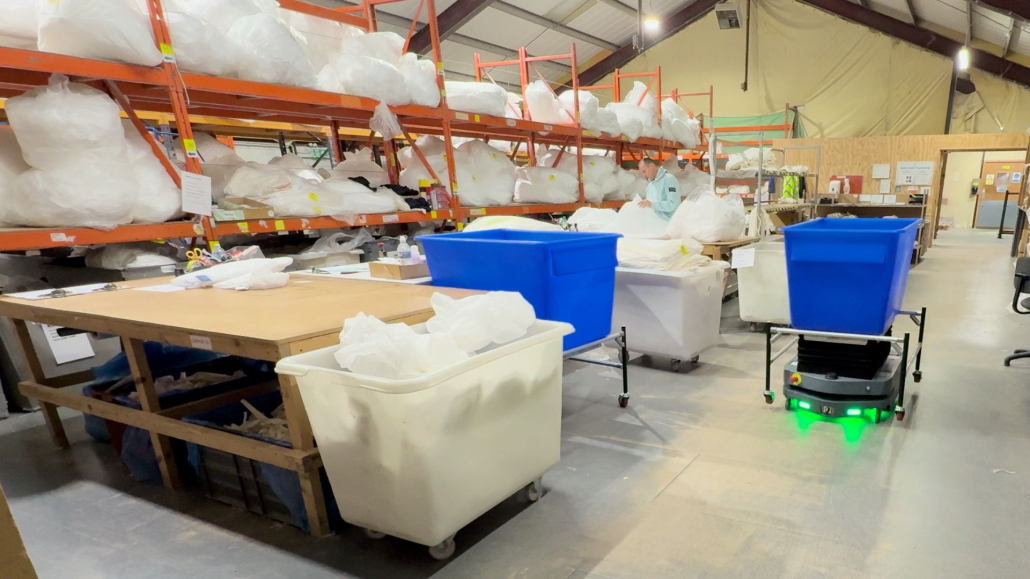
Allow the vehicles to integrate into live operations without redesigning workflows.
If the current process functions, let it function. Remove only the low-value transport layer that consumes skilled time.
Once performance is proven in your real environment, you can decide whether further optimisation is worthwhile. You may discover that incremental adjustments unlock more capacity. Or you may conclude that simply removing walking and manual handling has delivered the majority of the gain.
The order matters.
When automation demands organisational change before it demonstrates value, it becomes a strategic gamble.
When automation proves value within existing processes, it becomes an operational tool.
This is not simply a technical distinction. It is a commercial one.
SMEs in particular do not struggle because they lack ideas. They hesitate because the traditional automation model bundles together process redesign, capital investment and long payback periods. The perceived risk sits heavily with the production manager who sponsors the decision.
If instead automation can be trialled in live conditions, without CapEx, without installation fees, without long-term contractual lock-in, the conversation shifts from speculation to evidence.
You are not committing to a theory.
You are testing a constraint.
And if it does not deliver, you remove it.
In my experience, most factories do not need reinvention before they introduce autonomous vehicles. They need relief from non-value-adding movement that quietly absorbs 30-50% of a production worker’s time.
The strategic question for leadership is not whether your workflows are perfect.
It is whether you are structuring automation in a way that requires transformation before it earns its place.
How much of your hesitation around automation is really about the fear of changing processes that already work?
If you are considering automation, the question is not whether transformation is possible. It is whether value can be demonstrated first.
Explore automation without restructuring
If manual material transport is absorbing skilled time in your operation, learn more about Autonomous GO or arrange a site visit to evaluate this in your existing production environment.